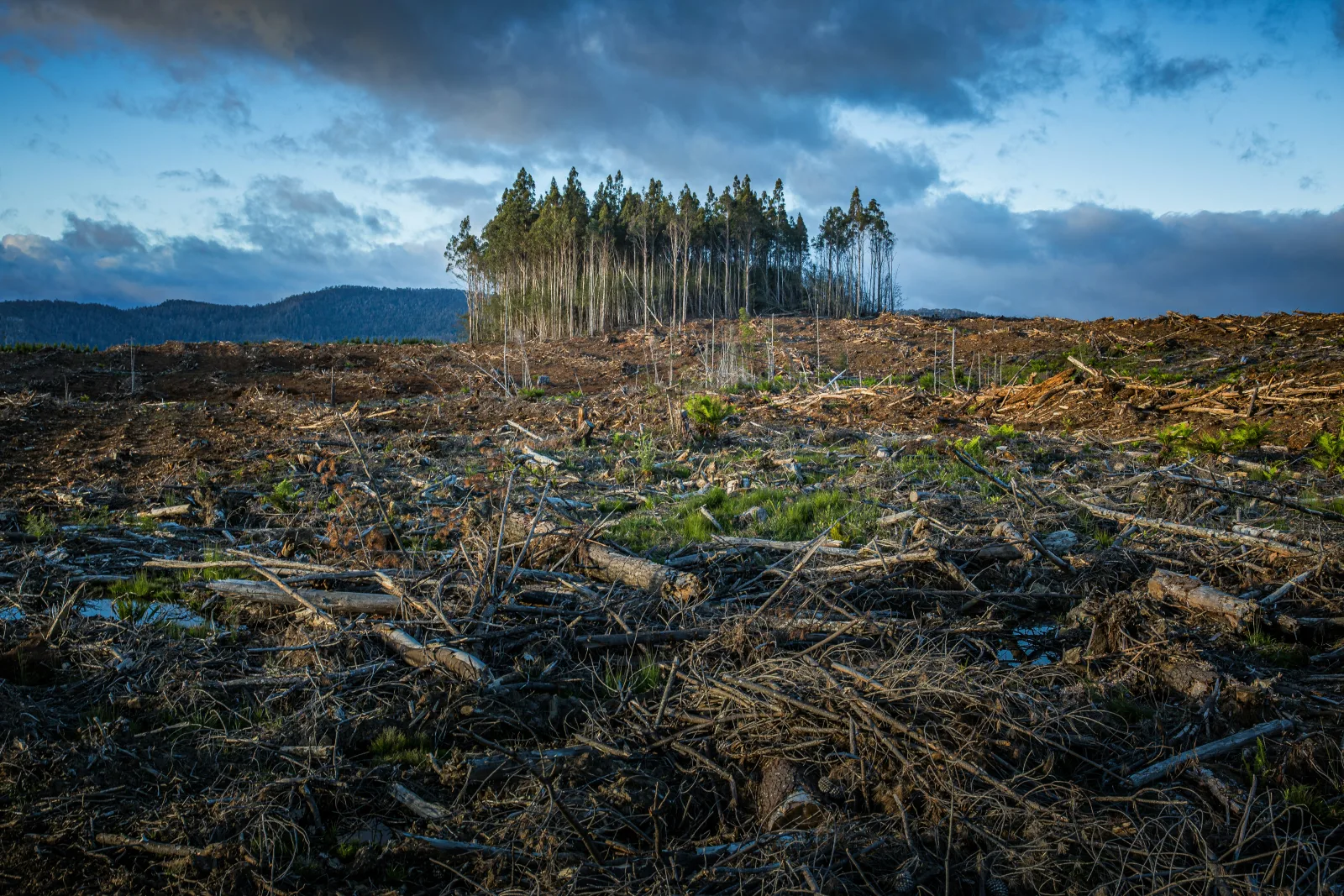
Seven Commodities: Cattle, Cocoa, Coffee, Oil Palm, Rubber, Soya, Wood
Key takeaway
Why these seven?
The EUDR's seven covered commodities were selected because they collectively account for the vast majority of agricultural deforestation linked to EU consumption. These are not arbitrary choices: each commodity has documented evidence of driving significant forest clearance in major producing regions, and the EU is a significant market for all of them.
The Annex I Logic: Commodities and Their Products
The EUDR operates on two levels. At the top level are the seven relevant commodities: the raw agricultural or forestry outputs that are associated with deforestation. Below them are the relevant products listed in Annex I: processed goods that contain, have been fed with, or have been made using those commodities. Both the raw commodity and the derived product trigger compliance obligations.
This two-level structure is essential to the regulation's effectiveness. If only raw commodities were covered, a company could import raw soy beans, process them into meal and oil within the EU, and sell the processed products without any traceability to the original farm. By covering processed products, the EUDR closes this gap and ensures that value chain processing does not break the compliance chain.
Cattle and Cattle Products
Cattle ranching is the single largest driver of deforestation in the Brazilian Amazon and Cerrado. When a forest is cleared for pasture, the cattle production that follows is linked to that deforestation event even if the animals are sold years later to different farms.
The EUDR covers not just live cattle and fresh or frozen bovine meat, but an extensive range of derived products:
- Leather and tanned leather products
- Leather footwear
- Collagen and gelatine derived from bovine hides
- Other products containing bovine leather as a significant component
This means that luxury goods brands selling leather handbags, footwear manufacturers, and food companies using bovine gelatine are all within scope. The supply chain complexity for cattle is particularly high because animals frequently move between multiple farms before slaughter, and the hides travel a separate path from the meat, often to tanneries in different countries.
Key takeaway
Cattle cut-off: animals born before 29 June 2023 are out of scope
A specific carve-out applies to cattle. Under Art. 1(2) EUDR and the definition of "produced" in Art. 2(14), the regulation does NOT apply to cattle (or cattle-derived products) where the animal was born before 29 June 2023, the date the regulation entered into force (FAQ 1.26, V5). Operators handling cattle that pre-dates that birthday do not need to submit a DDS at all. For all cattle born on or after 29 June 2023, full traceability applies: every establishment where the animal was held, from birth through fattening to slaughter, must be geolocated.
A second clarification from V5 concerns feed for livestock. The EUDR only applies to feed if the feed itself is a relevant Annex I product (e.g. soybean meal, HS 1208 10). Grass and other non-relevant feed is outside the scope. When a relevant feed product is used to feed cattle that will be placed on the EU market, the cattle operator must keep evidence (invoices, DDS reference numbers from the feed supplier) that the feed was deforestation-free, covering the lifetime of the animal up to a maximum of five years (FAQ 1.26.1, V5).
Cocoa and Cocoa Products
Cote d'Ivoire and Ghana together produce approximately 60% of the world's cocoa, much of it from areas that were forest within living memory. Cocoa farming expansion has been identified as the primary driver of deforestation in West Africa for several decades. The EU imports approximately 40% of global cocoa production.
Covered products include:
- Cocoa beans and husks
- Cocoa paste, butter, and powder
- Chocolate and chocolate products (including confectionery containing cocoa)
Coffee and Coffee Products
Coffee is grown across tropical and subtropical regions, including Brazil, Vietnam, Colombia, Ethiopia, and Honduras. In Ethiopia, the birthplace of coffee, farming expansion threatens highland forests of exceptional biodiversity value. Vietnam's coffee boom drove significant forest loss in its central highlands. Uganda and other East African producers are experiencing growing pressure on forest lands from coffee cultivation.
Covered products include:
- Raw (green) coffee beans and roasted coffee
- Coffee extracts, essences, and concentrates
- Preparations and mixtures containing coffee
Oil Palm and Palm-Derived Products
Palm oil is the world's most widely consumed vegetable oil and has been the primary driver of deforestation in Indonesia and Malaysia, which together account for approximately 85% of global palm oil production. Peatland forests destroyed for palm oil plantations release extraordinary quantities of stored carbon per hectare cleared.
Palm oil's pervasiveness in processed foods, cosmetics, and biofuels makes this one of the most complex supply chains under the EUDR. Covered products include:
- Palm oil and palm kernel oil
- Palm fatty acids and crude glycerol
- Margarine, shortening, and similar products
- Other food products containing palm oil as an ingredient
- Cosmetic and personal care products containing palm-derived ingredients
Rubber and Rubber Products
Natural rubber is produced primarily in Thailand, Indonesia, and Vietnam from the Hevea brasiliensis tree. Rubber plantation expansion historically replaced natural forests across Southeast Asia. Thailand, Indonesia, and Vietnam together account for approximately 70% of global natural rubber production.
Covered products include:
- Natural rubber and latex
- Rubber tyres and inner tubes
- Vulcanised and hardened rubber products
- Rubber gloves, tubes, and other articles
The inclusion of rubber tyres is particularly notable, drawing automotive manufacturers directly into the EUDR's compliance framework.
Soya and Soy-Derived Products
Soybean cultivation is the second-largest driver of deforestation in Latin America after cattle ranching, and the two are closely linked: soy is grown partly to feed the cattle that occupy cleared land further into the frontier. Brazil, Argentina, and Paraguay are the dominant producing countries for EU imports.
Covered products include:
- Soya beans and soya bean oil and meal
- Animal feed preparations containing soya
- Soya flour, groats, and textured soya protein
- Other food products where soya is a significant ingredient
Wood and Wood-Derived Products
Wood was already covered by the predecessor EU Timber Regulation, which required operators to verify that timber had been legally harvested. The EUDR raises the bar: it requires not just legality but proof that wood was harvested without inducing forest degradation after 31 December 2020. The definition for wood differs slightly from the other commodities: it must be shown that harvesting did not cause forest degradation, not just deforestation.
The coverage of wood-derived products is the most extensive of any commodity group:
- Sawn timber, veneer, plywood, and particle board
- Pulp, paper, and paperboard
- Furniture containing wood
- Printed books, newspapers, and periodicals
- Wooden packaging materials
- Palm hearts (grouped with wood for regulatory purposes in Annex I)
Worked example
A published novel and a car tyre: both within EUDR scope
A European book publisher printing novels on paper sourced from wood pulp must ensure that the wood used to make that pulp did not come from forests degraded after 31 December 2020. A European car tyre manufacturer sourcing natural rubber from Indonesian or Thai plantations must ensure those plantations were not established on forest land cleared after that date. The EUDR's product scope reaches into sectors that many businesses did not initially consider forest-related at all.
No certification scheme alone provides automatic EUDR compliance. The regulation makes this explicit in its Recitals and FAQ. Certified products and supply chains can serve as one element of evidence within a due diligence system. Certification can reduce the risk assessment workload by providing independently verified information about production practices. However, operators must still:
- Collect geolocation coordinates of all production plots.
- Conduct a risk assessment using the information collected.
- Submit a due diligence statement before placing products on the market.
The Commission has indicated it may recognise certain certification schemes as providing supporting evidence in the risk assessment step, but this recognition does not substitute for the information collection and statement submission requirements. An operator cannot simply present an FSC or RSPO certificate and consider their obligations fulfilled.
Key Takeaways
- The EUDR covers seven commodities selected because they collectively account for the vast majority of EU-linked deforestation: cattle, cocoa, coffee, oil palm, rubber, soya, and wood
- Annex I extends coverage from raw commodities to derived products, preventing value chain processing from breaking the compliance chain: leather goods, chocolate, tyres, furniture, and printed books are all in scope
- Each commodity is linked to specific high-deforestation regions: cattle and soy to South America, palm oil to Southeast Asia, cocoa to West Africa, coffee to multiple tropical regions, rubber to Southeast Asia, and wood to multiple global origins
- Certification schemes (FSC, RSPO, Rainforest Alliance) do not substitute for EUDR due diligence: they can support risk assessment but operators must still collect geolocation data and submit due diligence statements
- The inclusion of rubber tyres and printed books illustrates how broadly the EUDR reaches into manufacturing sectors not traditionally associated with forest risk
Knowledge Check
Test what you just learned
3 questions · check each one as you go
Why does the EUDR cover derived products (like chocolate, leather bags, and furniture) in addition to raw commodities (like cocoa, cattle, and wood)?
Which two countries together produce approximately 85% of global palm oil, making them the primary focus of palm oil-related EUDR compliance?
For wood products specifically, what does the EUDR require operators to demonstrate, beyond what the predecessor EU Timber Regulation required?