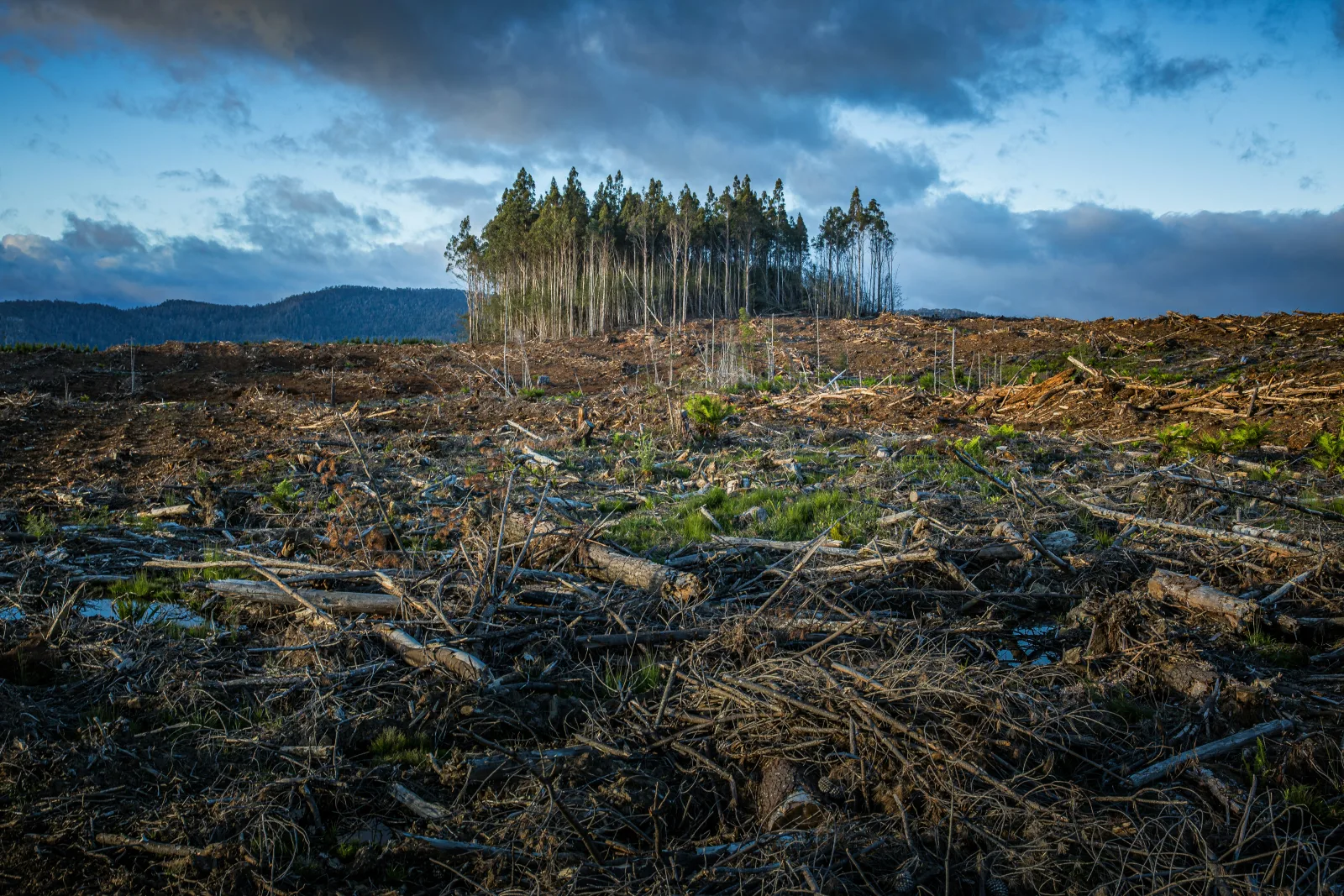
The EU's Deforestation Footprint
Key takeaway
The core problem the EUDR addresses
European consumers are connected to deforestation through their daily purchases, whether they know it or not. The EU is estimated to drive approximately 10% of global deforestation through its consumption of forest-risk commodities. The EUDR is the legislative response to that responsibility.
How Consumption Drives Deforestation
The link between European supermarkets and South American or Southeast Asian forests may not be immediately obvious, but it is direct and well-documented. When a European food company purchases soy-based animal feed grown on land that was Cerrado forest six months ago, or when a European retailer sells chocolate made from cocoa farmed in an area that was rainforest until last year, European consumption has funded and incentivised that deforestation.
This is what economists call an embedded deforestation footprint: the deforestation that is embodied within the goods a country or region imports and consumes. The European Commission's 2021 Impact Assessment (SWD(2021) 315) concluded that EU consumption patterns drive approximately 10% of global deforestation. This places the EU among the world's largest drivers of forest loss, alongside domestic demand within Brazil, Indonesia, and China.
Analogy
Think of it like a carbon footprint, but for forests
Just as a carbon footprint measures the greenhouse gas emissions associated with a person's or organisation's activities, a deforestation footprint measures the forest area cleared to produce the goods they consume. The EU's deforestation footprint is large because Europe imports enormous quantities of commodities that are produced on land often converted from tropical forest.
What the EU Imports and Where It Comes From
The European Commission's Impact Assessment examined EU imports commodity by commodity. The picture is striking:
| Commodity | EU's Global Role | Key Sourcing Regions |
|---|---|---|
| Soya | approx. 75% of EU soy demand linked to South American deforestation risk | Brazil, Argentina, Paraguay |
| Palm oil | Significant share from high-deforestation areas | Indonesia, Malaysia |
| Cocoa | approx. 40% of global cocoa imports flow through the EU | Cote d'Ivoire, Ghana |
| Coffee | Major consumer; EU imports from multiple regions | Brazil, Vietnam, Colombia, Ethiopia |
| Cattle/beef | Imports from South America with Amazon-linked risk | Brazil, Argentina, Uruguay |
| Rubber | Significant importer of natural rubber | Thailand, Indonesia, Vietnam |
| Wood/timber | Major global importer; covered under earlier EUTR | Global, including tropical origins |
The soy case illustrates the issue most starkly. The vast majority of EU soy is not consumed directly by people: it is used as animal feed for pigs, poultry, and dairy cattle. Every kilogram of pork or chicken consumed in Europe therefore has an indirect connection to the landscapes of South America where that soy was grown.
Why the EU Bears Responsibility
The EUDR's Recitals make the normative case explicitly. European citizens benefit economically from importing commodities produced in countries with lower land costs, weaker environmental regulations, and abundant natural resources. When those advantages derive in part from the clearance of ecologically critical forests, the EU market is functioning as a financial incentive for deforestation.
The regulation frames this not as a matter of blaming producer countries but as a matter of shared responsibility. The Recitals note that the EU, as a major consumer and importer, has both the power and the obligation to ensure that its consumption does not contribute to global environmental harm. This is the foundational principle of supply chain due diligence as a policy tool.
Worked example
The cocoa-chocolate supply chain: a case study in embedded deforestation
Cote d'Ivoire and Ghana together produce approximately 60% of the world's cocoa. Much of this cocoa is grown in areas that were forest decades ago. The European Commission's Impact Assessment found that EU cocoa imports account for roughly 40% of global cocoa trade, making European chocolate manufacturers and retailers the single largest market for what is also one of the world's most deforestation-linked commodities. The EU's demand for cheap cocoa has historically incentivised expansion of cocoa farming into protected and unprotected forest areas alike.
Quantifying the Projected Impact
The Commission's Impact Assessment also modelled the potential benefits of addressing the EU's deforestation footprint through regulation. If the EUDR achieves full compliance across all covered commodities, the projections are substantial:
- An estimated 71,920 square kilometres of forest saved annually, roughly the size of Ireland.
- At least 32 million tonnes of CO2 equivalent in greenhouse gas emissions avoided per year from the deforestation that would otherwise occur.
- Significant biodiversity co-benefits from protecting critical habitat for endangered species.
These figures represent minimum estimates under the assumption of full compliance. The actual environmental benefit would be larger if the regulation also shifts global supply chain norms, encourages sustainable land use in producer countries, and catalyses similar regulations in other major importing markets.
The Limits of Voluntary Action
Before the EUDR, the EU's approach to its deforestation footprint was largely voluntary. Companies were encouraged to join roundtables on sustainable palm oil (RSPO), soy (RTRS), or cocoa, and to seek certification from bodies such as the Forest Stewardship Council (FSC) or Rainforest Alliance. Industry associations made non-binding commitments to deforestation-free sourcing.
The Impact Assessment concluded that these voluntary measures had comprehensively failed to halt the EU's contribution to deforestation. Less than 20% of globally traded deforestation-risk commodities were covered by independent third-party sustainability certification as of 2021. Certification uptake was uneven, concentrated among larger companies in certain sectors, and did not reach the smallholder supply chains that account for a significant share of high-risk production.
The voluntary approach also suffered from a structural disadvantage: companies that invested in sustainable sourcing faced higher costs than competitors that did not, creating a race to the bottom. Mandatory regulation levels the playing field, ensuring that every operator placing goods on the EU market faces the same requirements.
The estimate that EU consumption drives approximately 10% of global deforestation comes from supply chain modelling studies commissioned by the European Commission. These studies trace the flow of commodities from production regions, through intermediaries and processors, to final consumption in the EU.
The methodology assigns a share of the deforestation in each producing region to each consuming region proportionally to its share of that region's commodity exports. So if the EU purchases 20% of Brazil's soy exports, and soy cultivation drove 10 million hectares of Brazilian deforestation in a given period, the EU is attributed with 2 million hectares of that deforestation.
This kind of consumption-based accounting is imprecise and contested, but it provides the most defensible basis for attributing global environmental impacts to consuming economies. The 10% figure should be understood as an order-of-magnitude estimate rather than a precise measurement.
Key Takeaways
- The EU's consumption of forest-risk commodities drives an estimated 10% of global deforestation, making it one of the world's largest consumers of deforestation-linked goods
- Key commodities linking EU consumption to deforestation include soy (primarily for animal feed), palm oil, cocoa, coffee, cattle products, rubber, and timber
- Voluntary certification schemes covered less than 20% of globally traded deforestation-risk commodities as of 2021 and proved insufficient to halt the EU's contribution to forest loss
- The EUDR's Impact Assessment projected that full compliance could save approximately 71,920 square kilometres of forest per year and avoid at least 32 million tonnes of CO2 equivalent annually
- The EUDR's rationale is that the EU, as a major importer and consumer, bears shared responsibility for the environmental consequences of its demand and must use its market power to stop incentivising deforestation
Knowledge Check
Test what you just learned
3 questions · check each one as you go
According to the EU's 2021 Impact Assessment, approximately what share of global deforestation is driven by EU consumption?
Why did the European Commission's Impact Assessment conclude that voluntary certification schemes were insufficient?
What is the estimated annual greenhouse gas emission reduction if the EUDR achieves full compliance?