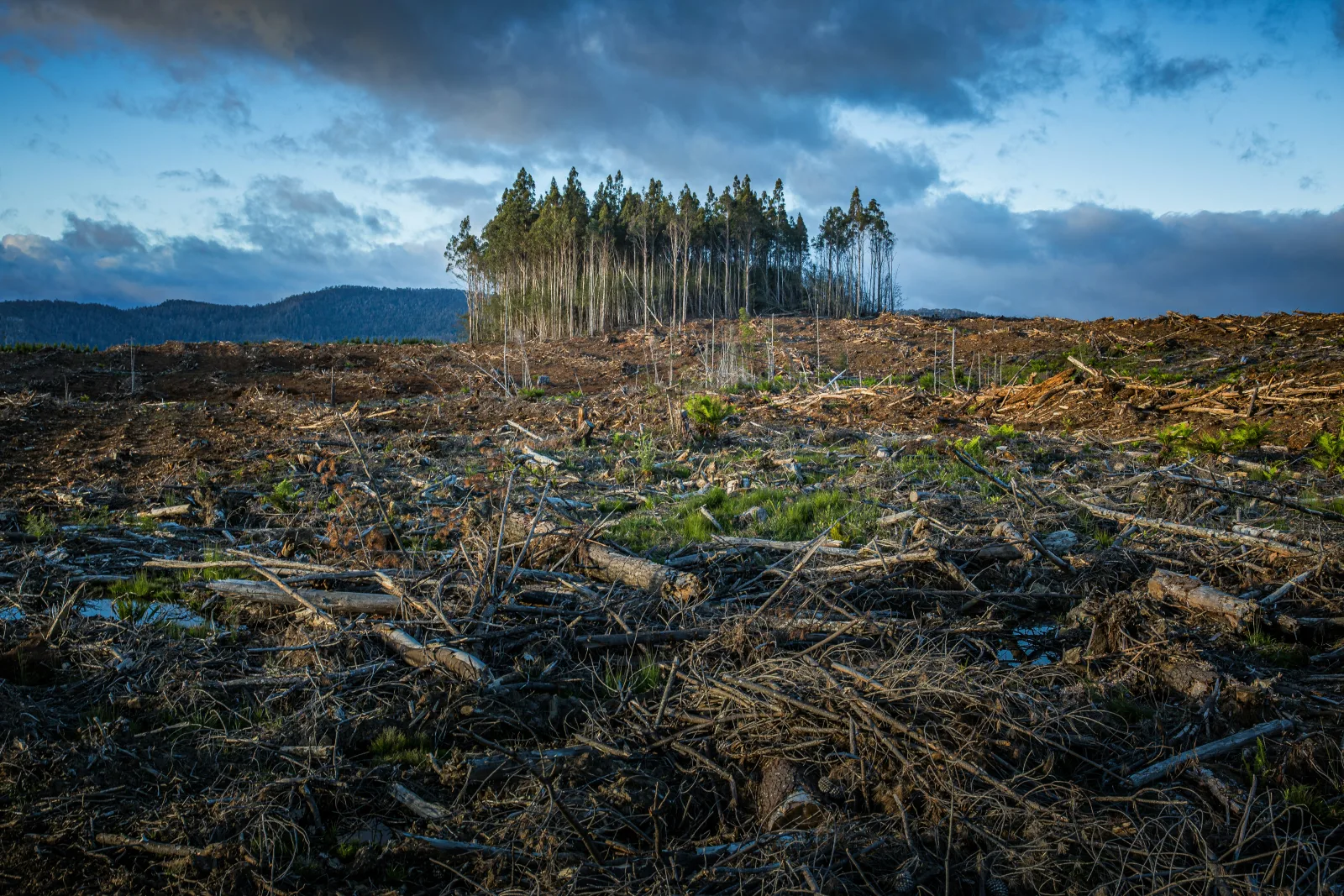
The Scale of Global Deforestation
Key takeaway
Why this matters for the EUDR
The EU Deforestation Regulation was created in direct response to a global crisis: over 420 million hectares of forest have been destroyed since 1990. Understanding the scale and drivers of that crisis is essential to grasping why mandatory, legally binding action was necessary.
How Much Forest Does the World Have?
Forests are the largest terrestrial ecosystem on Earth. According to the FAO Global Forest Resources Assessment, the world currently holds approximately 4.06 billion hectares of forest, covering around 31% of the planet's total land area. Put another way, that is roughly 0.52 hectares for every person alive today.
These forests are not evenly distributed. Five countries alone hold more than half the world's forest area: the Russian Federation, Brazil, Canada, the United States, and China. The top ten countries account for approximately two-thirds of all global forests. This concentration matters because it means that policy decisions in a handful of nations have an outsized influence on the health of the world's forests.
Analogy
Putting the numbers in perspective
Since 1990, the world has lost forest equivalent in area to the entire European Union. The EU has a land area of roughly 4.2 million square kilometres. Losing 420 million hectares of forest over three decades means we have cleared a territory the size of all 27 EU member states combined, and replaced it mostly with farmland.
How Fast Are We Losing Forests?
The rate of forest loss has slowed compared to the 1990s, but it remains extremely high in absolute terms. The FAO reports the following approximate rates of deforestation by decade:
| Period | Approximate Annual Forest Loss | Context |
|---|---|---|
| 1990s | approx. 16 million hectares/year | Highest rate in recorded history |
| 2000s | approx. 10 million hectares/year | Slowed due to some policy action |
| 2010-2020 | approx. 10 million hectares/year | Plateau; limited further reduction |
| 2024 | 30 million hectares (tree cover) | Record high, partly fire-driven |
The net loss figure tells a slightly different story. When forest gain (through natural regrowth and deliberate planting) is subtracted from gross loss, the net annual loss in 2015-2020 was approximately 4.7 million hectares per year. That is still an enormous number, equivalent to losing an area the size of Denmark every single year.
What Kind of Forests Are Being Lost?
Not all forest loss is equal. The FAO distinguishes between primary forests, naturally regenerating forests, and planted forests. Primary forests, sometimes called old-growth or intact forests, are the most ecologically valuable. They have evolved over centuries or millennia and contain biodiversity and carbon stocks that cannot be replicated once destroyed.
Over 80 million hectares of primary forest have been lost since 1990. These forests currently cover 1.11 billion hectares globally, representing just over a quarter of all forests. Crucially, primary forests store an estimated 250 billion tonnes of carbon in biomass and soils. When they are cleared, that carbon enters the atmosphere, and the intricate web of species they support collapses.
Worked example
The 2024 record: a snapshot of accelerating loss
Global Forest Watch reported that the tropics lost 6.7 million hectares of primary rainforest in 2024, an increase of 80% compared to 2023. Greenhouse gas emissions from this loss alone reached 3.1 gigatonnes of CO2 equivalent, roughly equivalent to India's entire annual fossil fuel emissions. The loss rate in 2024 equalled 18 football fields of primary forest per minute, every minute of every day.
The Main Drivers: Agriculture Above All
Forests are lost for many reasons, including infrastructure development, urbanisation, and fire. But the single dominant driver globally is agricultural expansion. Studies consistently estimate that agricultural conversion accounts for approximately 73% of all tropical deforestation, split roughly between large-scale commercial agriculture (around 40%) and local subsistence farming (around 33%).
The commodities most directly linked to tropical deforestation are the same ones that appear in the EUDR's list of covered commodities:
- Cattle ranching is the primary driver in Latin America, particularly the Brazilian Amazon and Cerrado.
- Soybean cultivation is a major driver in South America's Cerrado and the Amazon frontier.
- Palm oil is the primary driver of forest loss in Indonesia, Malaysia, and parts of Africa.
- Cocoa drives deforestation in West Africa, above all in Cote d'Ivoire and Ghana.
- Coffee is a growing concern in Ethiopia, Uganda, and other East African highland forests.
- Rubber historically replaced natural forests across Southeast Asia.
- Timber and logging enable agricultural access through road-building and cause direct forest loss.
Regional Patterns of Forest Loss
Forest loss is geographically concentrated. South America records the largest absolute area of tropical forest loss. The Brazilian Amazon is the single most important remaining tropical rainforest on Earth, and it experienced severe deforestation between 2017 and 2020 during a period of weakened environmental enforcement. The Cerrado, Brazil's tropical savanna, has lost more than half of its native vegetation.
Africa records the second-highest deforestation rate. The Democratic Republic of Congo holds the world's second-largest tropical rainforest and is under intense pressure from shifting cultivation and charcoal production. West Africa has already lost the majority of its original forest cover.
Southeast Asia, and particularly Indonesia and Malaysia, has experienced very high deforestation rates relative to forest area. Palm oil and pulpwood plantations have replaced vast areas of natural forest, and the destruction of peat forests releases extraordinarily high carbon emissions per hectare. One positive signal: Indonesia achieved an 11% decrease in primary forest loss in 2024 through sustained policy effort, demonstrating that good governance can make a measurable difference.
Why Forests Matter Beyond Trees
Forests are not simply a collection of trees. They are complex ecosystems that underpin planetary stability in at least three ways that are directly relevant to understanding the EUDR's purpose.
Climate regulation: Forests store an estimated 662 billion tonnes of carbon in biomass and soil. Intact forests absorb approximately 2.6 gigatonnes of CO2 per year from the atmosphere. Degraded and deforested areas release approximately 4.8 gigatonnes per year, meaning that net forest loss has turned tropical forests from carbon sinks into carbon sources.
Biodiversity habitat: Forests host an estimated 80% of the world's terrestrial biodiversity. Tropical forests alone, covering only around 10% of land area, contain more than 50% of all terrestrial species. The 2024 Global Forest Watch report estimates that 70% of terrestrial vertebrates depend on forests for habitat.
Water cycle regulation: The Amazon forest generates approximately 20 billion tonnes of water vapour per day, creating atmospheric rivers that deliver rainfall across South America. Scientists estimate that losing the Amazon could reduce rainfall by 20% in major agricultural regions, including the very areas that grow soy and coffee for EU markets.
The FAO definition of deforestation, which is the one the EUDR adopts, requires conversion of forest to another land use. Not all tree cover loss counts as deforestation. Timber harvesting followed by natural regeneration is forest disturbance, not deforestation. A plantation forest that is harvested and replanted is managed production forest, not deforestation.
Under the FAO definition, a forest is land spanning more than 0.5 hectares with trees taller than 5 metres and a canopy cover exceeding 10%, or trees capable of reaching those thresholds. This definition explicitly excludes land predominantly under agricultural or urban use, meaning that a grove of trees within a farm does not constitute a forest for regulatory purposes.
The EUDR also covers forest degradation, which refers to structural changes to forest cover, specifically the conversion of primary or naturally regenerating forests into plantation forests or other wooded land. Degradation without full clearing is thus also regulated for wood products under the EUDR.
Key Takeaways
- The world has lost 420 million hectares of forest since 1990, equivalent to the entire land area of the European Union
- Current annual forest loss is approximately 10 million hectares per year gross, with a net loss of around 4.7 million hectares after accounting for regrowth and planting
- Agricultural expansion accounts for approximately 73% of all tropical deforestation, driven primarily by cattle, soy, palm oil, cocoa, coffee, rubber, and timber
- Primary forests, covering 1.11 billion hectares, are irreplaceable repositories of biodiversity and carbon: over 80 million hectares have been lost since 1990
- Forests regulate climate, water cycles, and biodiversity, making their protection a foundational requirement for sustainable food production itself
Knowledge Check
Test what you just learned
3 questions · check each one as you go
According to the FAO Global Forest Resources Assessment, approximately how much forest has the world lost since 1990?
Which sector is responsible for approximately 73% of all tropical deforestation globally?
What does the FAO's definition of a 'forest' require regarding canopy cover?